
Home » Articles posted by InclusiveMuseums.org
Author Archives: InclusiveMuseums.org
Heritage Matters


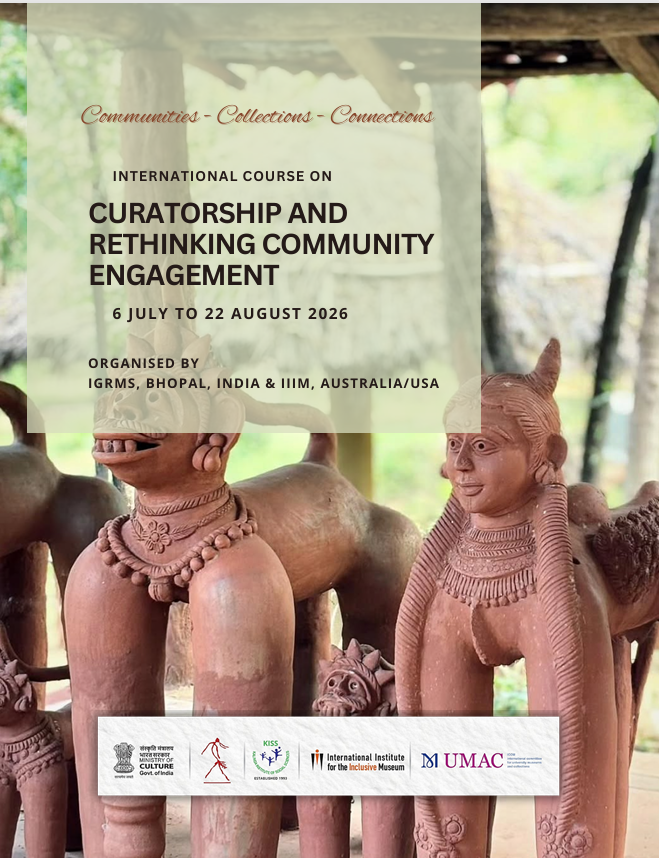

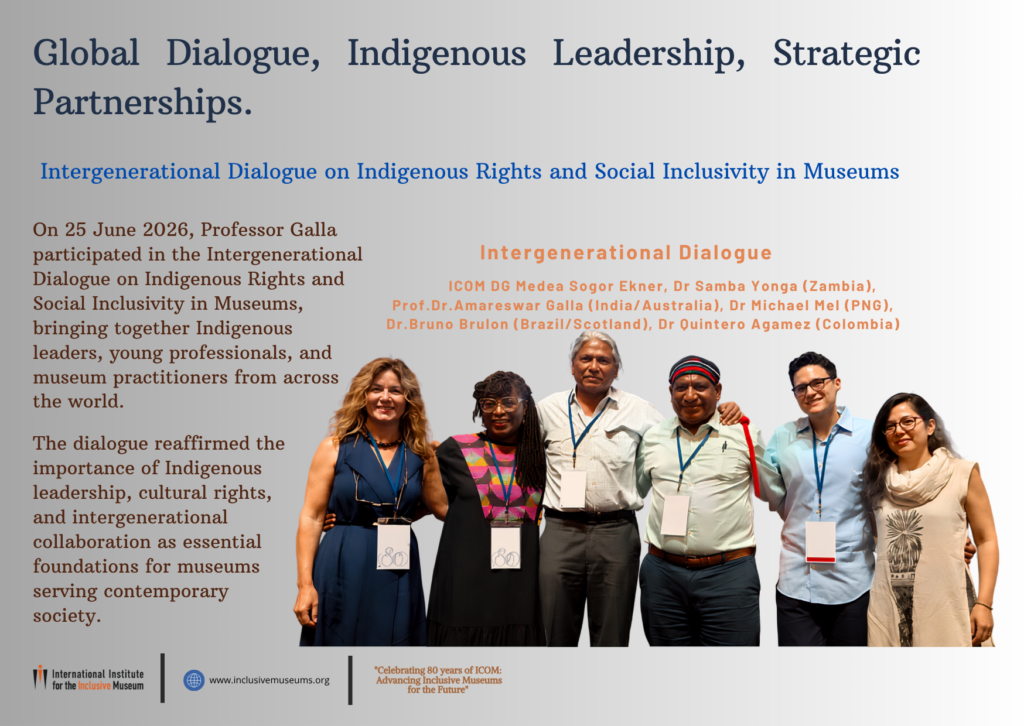
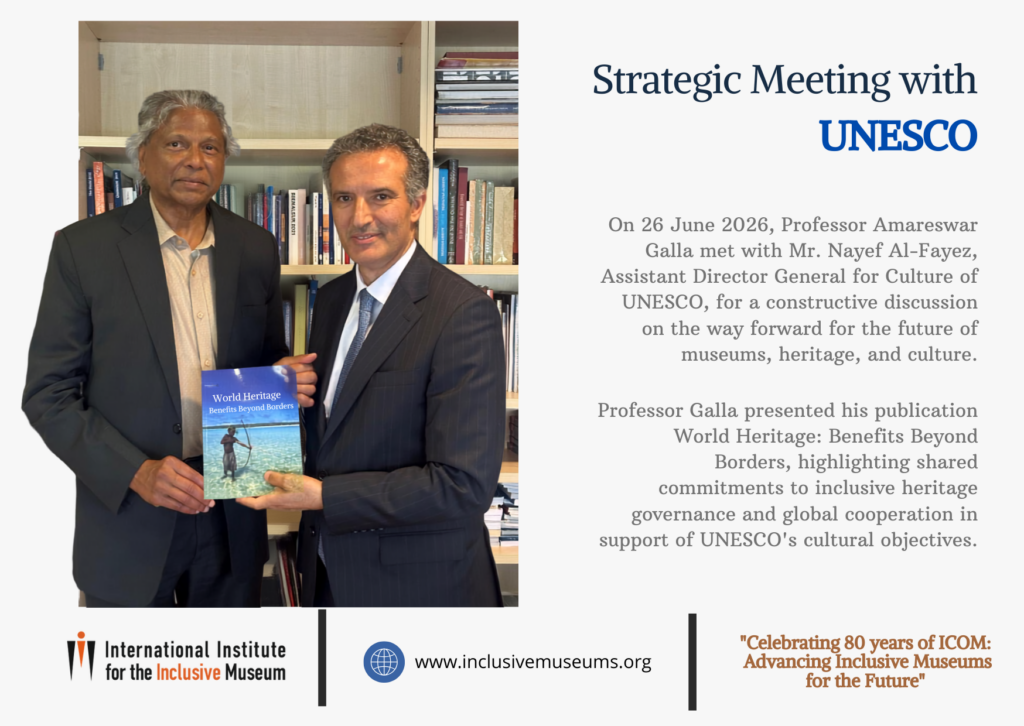
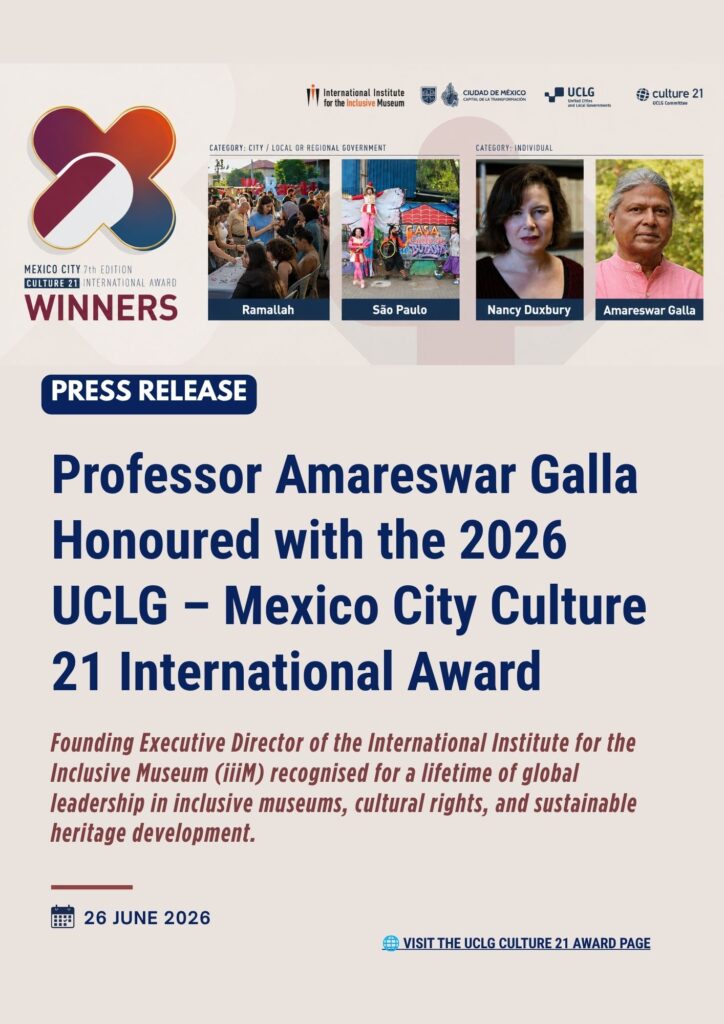
 View and download the PDF
 View and Download PDF
KIIT & KISS at the Forefront of Safeguarding Buddhist Heritage
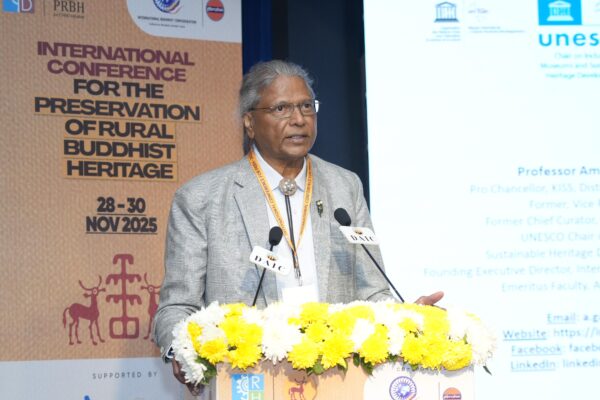
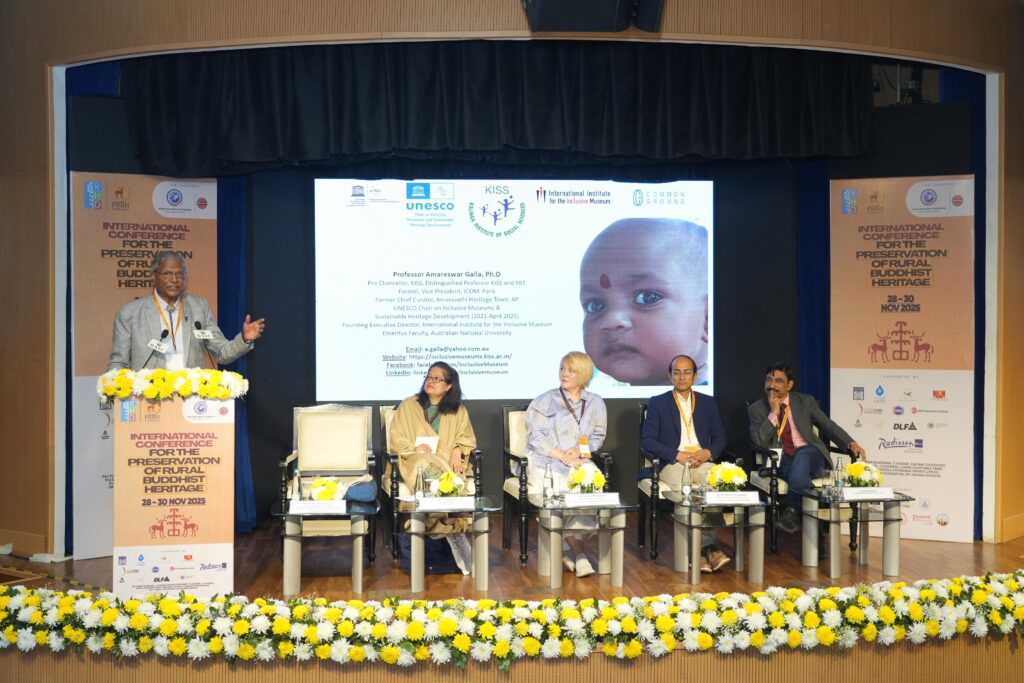
There is increasing concern across Asia—especially in India, China, Korea, and Japan—that, apart from iconic sites, more than 90% of Buddhist heritage remains unprotected. To address this situation, the International Academy for the Preservation and Management of Unprotected Buddhist Heritage and Sites in Rural Areas is being established by the Indian Trust for Rural Heritage and Development. Professor Dr. Amareswar Galla, Pro-Chancellor, KISS Deemed to be University, and Distinguished Professor of Indigeneity and Inclusive Museum & Heritage Studies at KISS-DU and KIIT-DU, addressed a major international conference at the end of last year on the proposal for the establishment of the Academy.
As a follow-up, a core team of experts met in Delhi on 7 February 2026 to discuss the structure and development of the Academy. Prof. Galla focused on his work with UNESCO, INTERPOL, and the International Council of Museums in securing the return of several stolen treasures, such as the Chandavaram Buddhist sculpture, to India from the National Gallery of Australia. He is also working with the KIIT School of Law to develop a programme on UNESCO International Heritage Law, the first of its kind in South Asia. This also bodes well for Odisha given the recent inscription by UNESCO, the serial nomination of the Odisha State’s Golden Triangle – Ratnagiri, Udayagiri, and Lalitgiri on India’s Tentative List for World Heritage status.

Honouring Heritage: International Day of the World’s Indigenous Peoples Celebrated at KISS
 Culture. Climate. Community.
The Kalinga Institute of Social Sciences (KISS) came alive with music, memory, and meaning as it celebrated the International Day of the World’s Indigenous Peoples on campus. The day, observed globally on August 9, was marked with a heartfelt tribute to indigenous identities, traditions, and leadership.
Under bright skies and surrounded by greenery, floral offerings were made to the statues of tribal freedom fighters — a gesture that symbolised deep reverence for the ancestors and elders who paved the way for today’s indigenous youth. The air was filled with the soulful rhythms of traditional tribal instruments, played with pride by KISS students, echoing stories of resilience and heritage.
Voices from the Celebration
In his keynote address, Prof. Amareswar Galla, Pro-Chancellor of KISS-DU and UNESCO Chair on Inclusive Museums and Sustainable Heritage Development, Anant National University, reflected on the urgent need for indigenous representation in leadership and policy-making.
“We must ensure that indigenous voices are heard — not just in cultural spaces, but in climate negotiations, political forums, and decision-making rooms,” he said. “Their lived knowledge is invaluable in addressing the world’s most pressing challenges.”
Joining virtually, Prof. Amitabh Pandey, Director of Indira Gandhi Rashtriya Manav Sangrahalaya, called for a shift in societal perspectives.
“It’s time to move away from colonial mindsets and toward celebration and empowerment of indigenous communities,” he said. “Preserving their arts, languages, and traditions must go hand in hand with ensuring their economic and social development.”
Prof. Deepak Kumar Behera, Vice Chancellor of KISS-DU, emphasized the central goal of the occasion:
“To raise awareness of indigenous rights, preserve their languages and cultures, and champion justice and dignity for indigenous peoples across the globe.”


A Gathering of Shared Purpose
The event witnessed a rich gathering of scholars, students, and international guests. Among the attendees were:
> Dr. Prashanta Routray, Registrar, KISS
> Prof. Neil Philip, New York City University
> Dr. Kahnu Charan Mahali, Director General of KISS University and Chief of the Tribal Advisory Council
> Dr. Arpana Premi Lina, Council Member
> Professors and faculty members from KISS University
Adding an international flair to the occasion, a delegation from New York City University joined the celebrations as part of their “India Trek” — a cultural immersion program designed to deepen global understanding of India’s indigenous wisdom and community-based knowledge systems.
Why This Day Matters

The International Day of the World’s Indigenous Peoples, observed annually on August 9, is more than just a celebration. It is a global call to acknowledge, protect, and empower over 476 million indigenous peoples across more than 90 countries. With unique cultures, languages, and ways of living, they are also among the most vulnerable — facing exclusion, marginalisation, and climate change impacts.

By commemorating this day, KISS reaffirms its commitment to indigenous rights, inclusive education, and community-led development. It stands as a beacon of hope where tradition meets transformation, and where every student is reminded: your roots are your strength.
KISS Hosts Roundtable of UNESCO Chairs in South Asia – Strengthening Regional Collaboration for Sustainable Development

Kalinga Institute of Social Sciences (KISS) successfully hosted the Roundtable of UNESCO Chairs in South Asia on 18th–19th March 2024, bringing together distinguished academic leaders to strengthen regional collaboration and advance shared priorities.
The roundtable was convened by Prof Amareswar Galla, Pro-Chancellor and Distinguished Professor of Indigeneity and Inclusive Museum & Heritage Studies at KISS-DU. Prof Galla also holds the position of UNESCO Chair on Inclusive Museums and Sustainable Heritage Development at Anant National University, Gujarat.
This significant gathering saw participation from 16 UNESCO Chairs representing institutions across India, Sri Lanka, and Nepal. Also in attendance were Mr. Tim Curtis, Director and UNESCO Representative to the Regional Office in New Delhi (serving Bangladesh), along with senior UNESCO specialists and staff.

The event provided a platform to:
∆ Strengthen the UNESCO Chairs network across South Asia
∆ Exchange insights on key regional priorities
∆ Explore collaborative ways in which the Chairs can contribute to addressing pressing global and local challenges

About the UNESCO Chairs Programme
Launched in 1992, the UNITWIN/UNESCO Chairs Programme aims to foster international cooperation and networking among higher education institutions worldwide. With over 950 UNESCO Chairs and 45 UNITWIN Networks across 120 countries, the programme facilitates the pooling of academic and institutional expertise to contribute to the UN 2030 Agenda for Sustainable Development.
The programme supports interdisciplinary teaching, research, training, and community engagement, serving as both a global observatory and a laboratory of ideas. In South Asia, there are currently 16 UNESCO Chairs, including 3 from Nepal and Sri Lanka, all working towards inclusive and sustainable development.

KISS is proud to have hosted this momentous event, reaffirming its commitment to global partnerships in knowledge sharing and social transformation.
2023 Jeonju International Awards for Promoting Intangible Cultural Heritage (JIAPICH) | South Korea
The anticipation is palpable as we approach the eagerly awaited announcement of the JIAPICH finalists. In this monumental event of 2023, we are delighted to disclose that Prof. Galla holds the prestigious position of Chair of the Jury for the Jeonju International Awards for Promoting Intangible Cultural Heritage (JIAPICH). The JIAPICH team is on the verge of unveiling the highly anticipated list of finalists. We extend a warm invitation for you to stay tuned for this momentous update, a celebration of those committed to safeguarding and promoting intangible cultural heritage. Join us in this thrilling moment as we anxiously await the announcement!
World Anthropology Congress Closes with Focus on Tribal Empowerment, Education, and Cultural Preservation

The curtains have come down on the World Anthropology Congress (WAC) at KISS Deemed to be University, but its echoes continue to resonate across the global anthropological landscape. The valedictory session, graced by Shri Arjun Munda, Hon’ble Union Minister of Tribal Affairs, shed light on the remarkable confluence of history, culture, and academia.
Minister Munda’s speech delved into the pivotal role of Emperor Ashoka in promoting world peace and highlighted the profound connection between the cult of Jagannath and tribal culture. He stressed the need for indigenous people to engage in self-reflection and research within their own communities, emphasizing that quality education is the key to empowering them to address their issues independently.
Moreover, Minister Munda expressed the readiness of the Tribal Affairs Ministry to collaborate on establishing a world-class museum for indigenous communities at KISS University, awaiting a formal proposal from the Odisha Government.
Dr Achyuta Samanta, Founder of KIIT & KISS, received accolades for his visionary leadership and dedication to providing free education to tribal students. He underlined KISS as the ideal venue for the World Anthropology Congress and celebrated the university’s status as the “largest anthropological laboratory of the world.”
Prof Deepak Kumar Behera, VC, KISS-DU, and President of the United India Anthropology Forum (UIAF), shared the staggering statistics of the event, which featured 350 sessions, 20 round-table meetings, 20 workshops, and 120 panel discussions. More than 1,100 anthropologists from 51 nations presented 1,200 research papers, supported by 8 pre-congresses and 10 post-WAC sessions.
The global acclaim for this congress extended beyond borders. Prof Anand Singh from the University of KwaZulu-Natal, South Africa, commended Dr. Samanta’s commitment to tribal education. Prof P. C. Joshi, WAC Chairman and former Vice-Chancellor of Delhi University, hailed this as the most accessible and affordable anthropology congress ever, citing the unique initiatives undertaken by KISS.
Prof Charlotte Ann Roberts, a Fellow of the British Academy from Durham University, UK, lauded the astounding success of the Congress, underlining its significance in the field of anthropology.
Amidst these remarkable achievements and discussions, Prof Dr Amareswar Galla, from the UNESCO Chair on Inclusive Museums and Sustainable Heritage Development at Anant National University, Ahmedabad, and Emeritus Faculty at the Australian National University, emerged as a prominent advocate. He envisioned the Congress as a turning point in tribal empowerment and suggested KISS consider launching an international program on applied museum anthropology to nurture professionals capable of managing tribal museums.
As the World Anthropology Congress 2023 draws to a close, Professor Galla’s vision and the collective efforts of all involved promise a brighter future for indigenous communities worldwide, driven by education, cultural preservation, and empowerment.
